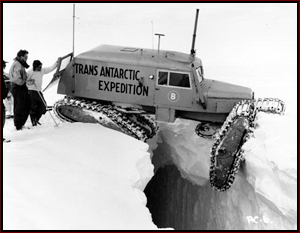
 Antarctica’s history, as short as it might be, regales us with tales of man’s quest for the South Pole. In the early 1900’s, explorers like Shackelton, Amundsen, and Scott risked (and some gave) their lives to be the first to stand on the most southerly point on the face of the earth.
At the time, 90 degrees south was just an arbitrary number, just a spot on a blank map where all the lines of longitude converged. There is nothing there of course, unless you considered the wind, the cold, and 360 degrees of frozen white loneliness that seems to stretch into eternity.
The early explorers believed that no one would follow in their footsteps, that they would be the first and the last men to visit the South Pole. Who would have ever thought such a desolate, godforsaken place would become “home” to an entire settlement of people? Or that the Polar Plateau would become one of the most sought after areas for scientific research.
Today, Amundsen-Scott South Pole Station, or simply ‘Pole’ as the locals call it, is home to over 200 residents during the austral summer and dwindles to around 50 during the winter. There are several buildings, including an Observatory, ‘The Dome’, a variety of Jamesways (tent structures), and a newly developed South Pole Station, complete with cafeteria, growth pod (greenhouse), and state of the art gymnasium.
Year-round habitation of the South Pole would not be possible without an abundant source of energy. The bulk of that energy supply is furnished by burning fossil fuels, primarily AN-8 a kerosene based jet fuel.
Since the 1950’s, Pole has relied entirely on aircraft to support its fuel needs. In the recent summer seasons the number of LC-130 flights to the South Pole has topped over 200 flights during the short four month summer season, nearly 1/3 of which are used to transport fuel.
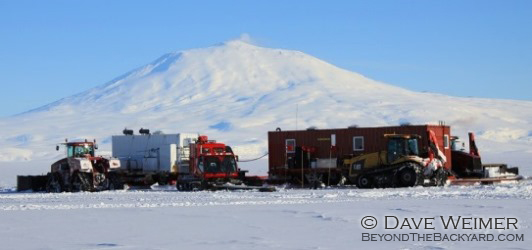
For the past decade, the US Antarctic Program has investigated the possibility of driving fuel by tractor train to the South Pole. Several tractors hauling fuel overland would not only be much more efficient but would also provide transport for items too large to fit in the belly of an LC-130. Furthermore, a successful delivery of fuel to the Pole would offset the number of required tanker flights and would make those planes available to support field camps in other areas of the continent.
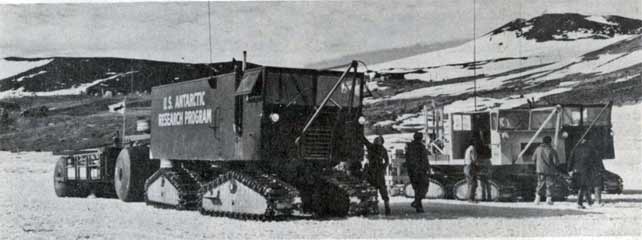 As novel as it sounds, driving tractor trains across Antarctica is nothing new.
Americans have been operating tractors around the continent for 60 years. The French, Russians, and South Africans all drive fuel to interior stations. Sir Edmund Hillary (of Mt. Everest fame) drove modified Ferguson tractors from Ross Island to the Pole in 1958. But it wasn’t until recently the vision of hauling fuel and supplies across 1,000 miles of frozen wasteland from McMurdo Station to the Pole had been realized.
2009-2010 marks the 7th season of the South Pole Traverse. And this is my journal. Enjoy

















 Beyond the Backyard